Divine Nature
The underlying latent principle, the Ultimate Reality, the First Cause of all causes, the Eternal Being on whom the Apparent Structure is founded is none other than the One God. The Cryptogram, which is Divine Signature, enabled this profound revelation of Its divine nature.
The Trinitarian Nature of God
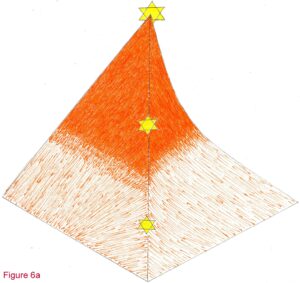
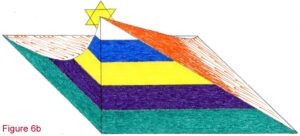
Realistically, the concept of the Three Persons in One God—the Trinity—is difficult to visualize from the human perspective and experience. However, by virtue of the Cryptogram, it is now possible to, logically, acquire knowledge of the concept, useful for operating within the Spiritual System. The Cryptogram depicts the Blessed Trinity. (Again, below are shown two detailed perspectives of the Cryptogram for ease of reference.)
God The Father
The infinite peak of the structure, the position illuminated by the brightest star, symbolizes God the Father:
. . . Who is the only Potentate, the King of kings, and Lord of lords; who only has immortality; dwelling in the light which no man can approach unto; whom no man has seen, nor can see; to whom be honor and power everlasting. Amen! (1 Timothy 6:15-16).
The portrayal of divine light in this passage reflects the Cryptogram, where an explosion of light emanates from the Throne of God the Highest—its intensity suddenly fading as it descends into the earthly realm. (C.f., “The Spiritual Light” in Blog Post 8; Proverbs 4:18-19). John testified to this truth:
This then is the message which we have heard of Him and declare to you that God is Light, and in Him there is no darkness at all (1 John 1:5).
As for the location of the Father’s Throne—at the Infinite Peak of the Structure—the Scriptures attested:
The Lord is high above all nations, and His Glory above the Heavens. Who is like our God enthroned on high and looks upon the Heavens and the Earth below? (Psalms 113:4-6).
Indeed:
For thus says the High and Lofty One [Himself] who inhabits eternity, whose name is Holy: ‘I dwell in the High and Holy Place . . .’ (Isaiah 57:15).
God the Father is the Ultimate Source of all things: the Standard of Perfection by whom all must strive to attain. Thus, the journey of the pilgrims, and the growth of the Apparent Structure are directed upward toward God the Father. As such, this pilgrimage is in accord with the petition in “the Lord’s prayer”: “. . . Your Kingdom come” (Matthew 6:9-13; Luke 11:2-4).
God The Son
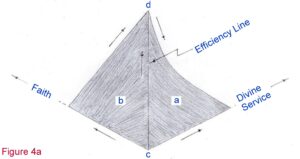
The long composite light source—the Efficiency Line—which stretches from the origin of the structure to the infinite peak, symbolizes God the Son. (See the Cryptogram Schematic, also, in Figure 4, below). It comprises infinite stars, approximate replicas of the Standard One at the Infinite Peak, each representing a position of a member of the sons of God. The position immediately adjacent to the Standard Spirit—God the Father—is a lesser, approximate replica of this Standard, with each subsequent position being a lesser approximation, forming a series of diminishing replicas down to the earthly plane. Through this gradation of the Father’s Spirit in the Son, pilgrims are able to approach the Father by degrees, who, otherwise, is transcendent at the Infinite Peak of the Structure.
Pilgrims reaching the Heavenly Sanctuary (the Efficiency Line) from the earthly plane below absorb the light of the star permanently and phosphoresce. Just as iron rods in a hot furnace become incandescent and glow, so the sedulous pilgrims who attain the relative summit are permeated by light, and share in divinity through the Son; hence they are called sons of God:
And because you are sons, God has sent forth the Spirit of His Son into your hearts, crying Abba, Father (Galatians 4:6).
For God who commanded light to shine out of darkness, has shined in our hearts, to give the light of the knowledge of the glory of God in the face of Christ [the efficiency line] (2 Corinthians 4:6).
This spiritual transformation, characteristic of those who come in close proximity to God, was first presaged by Moses’s partial transfiguration on Mount Sinai:
And when Aaron and the children of Israel saw Moses, behold, the skin of his face shone; and they were afraid to come near him (Exodus 34:30).
Jesus’s transfiguration on the mountain also typified this transformation:
And after six days, Jesus took Peter, James, and John his brother, and brought them up to a high mountain apart. And was transfigured before them; and His face did shine as the sun, and His raiment was white as the light (Matthew 17:1-2).
(Note that these two events occurred on top of mountains.)
Paul alluded to this mystery of God in the Son.
All things are of God, who has reconciled us to Himself by Christ, and has given to us the ministry of reconciliation. That is to say, that God was in Christ [the efficiency line], reconciling the world to Himself, not imputing their trespasses to them (2 Corinthians 5:18-19)
For through [Jesus] we both have access . . . to the Father (Ephesians 2:18).
It is by virtue of this Mystical Architecture—the Cryptogram—that Jesus, who personifies God the Son, made the following statements:
I am the Light [on the Ridgepole of the Structure] that is over all things . . . (Gospel of Thomas 77).
While you have the light, believe in the Light that you may become sons of the Light (John 12:36).
I am the Light of the world: he that follows me shall not walk in darkness but shall have the light of life (John 8:12).
While I am in the world, I am the Light of the world (John 9:5).
The following citations derive their significance from the Cryptogram’s structural feature of God the Son embodying God the Father:
I am the Way . . . no one comes to the Father but by me (John 14:6).
He that has seen me has seen the Father (John 14:9).
The Father and I are One (John 10:30).
And He that sees me sees Him that sent me (John 12:45).
But I am not alone because the Father is with me (John 16:32)
Observe that the Efficiency Line, which portrays the Son, is like a composite magnet that is pulling all magnetic materials (pilgrims) to itself out of a mixture containing other non-magnetic substances below (nonbelievers). This representation is consistent with Jesus’ statement:
Now is the judgment of this world; now shall the prince of this world be cast out [on surface-a]. And I, when I am lifted up from the Earth, will draw everyone to myself [on surface-b] (John 12:31-32).
(Note that Jesus’ “Magnetism” depended on His Ascension.) This magnet— God the Son—comprises infinite, tiny magnets (positions of the sons of God) linked side by side in a chain forming the Efficiency Line. The magnet exerts an attractive force on surface-b of the structure, and a repulsive one on surface-a.
When magnetic materials are under the influence of this magnet, they acquire magnetic properties themselves, which they, in turn, exert on other like substances and so on, resulting in a chain reaction. The strength of the magnetic pull is experienced mainly by those substances in direct contact with the magnet, and becomes progressively weaker farther away from the magnet.
The tiny magnets located high in the inclined chain of magnets (the Efficiency Line) have a proportionately greater magnetic field strength than the lower ones. As a result, the entire structure maintains a uniform magnetic field strength with respect to height—testimony to God’s Absolute Justice. This information is depicted in the Cryptogram by the gradation of light intensity. (See Figure 6).
God The Holy Spirit
The entire Potential Structure represents God the Holy Spirit. In the Heavenly Sanctuary (the Efficiency Line), It is one and the same with the Son. From the sanctuary, the Holy Spirit bifurcates and radiates like polarized beams of light constituting the pathways of the structure; as such, it exhibits different characteristics in surfaces a and b of the structure. The Light Source—the Unlit Torch—alone represents God the Son, it is the aggregate of the Source and Its Radiance—the Flaming Torch—that symbolizes the Holy Spirit.
Just as the sun’s rays pass through space, invisibly, until they strike matter (in the Earth’s atmosphere), so the Holy Spirit radiates through the Spiritual Structure, unnoticed, until It impacts a subject in Its path.
As the Apparent Structure, the Manifest Being, the Holy Spirit is revealed technically by pilgrims, as approximate images of the Father (the Star images), in two forms: as replicas and mirages or, if you will, actual and virtual images linked in chain formations to constitute the apparent pathways. But as the Potential Structure, the Unmanifest Being (the vacant portions of the framework), the Holy Spirit remains latent as approximate replicas and mirages of the standard star. As one moves down the structure from the peak, the star images, both the actual and the virtual, fade by degrees, eventually disappearing on the earthly plane.
The pathways of surfaces a and b are partial reflections or mirages of the Son’s body: The pathways of surface-a are reflections of the immature positions (the curve-shaped, lower portion of the Efficiency Line), while those of surface-b are reflections of the more advanced positions (the linear-shaped portion of the Efficiency Line). In fact, the Cryptogram is described by a mathematical function—an exponential or transcendental function—and the straight portions of the structure are linearization of this function; it is quite apt that the Transcendent God is, efficiently, described by a transcendent function.
The Holy Spirit is, therefore, the consummate representation of the Primal Spirit in Its diverse forms: In the Heavenly Sanctuary, He is the Standard Spirit, God the Father in union with His replicas—that is, God the Son—and in the rest of the structure, He is as mirages (or reflections) of the Father in the Son. Accordingly, reference has been made to the Three Persons in One God: Just as the Father is in the Son, so the Son is in the Holy Spirit. Indeed, the Scriptures affirm: “For through [Jesus] we both have access in One Spirit to the Father” (Ephesians 2:18). And so, the Holy Spirit is, ultimately, the “way” to the Father (cf., John 14:6). He is the total union of the Father and the Son: the All-encompassing Spirit—God the Mother. And so, in the Holy Spirit the Unity of the Divine is consummately expressed. Hence Jesus declared:
Whoever blasphemes against the Father will be forgiven, and whoever blasphemes against the Son will be forgiven, but whoever blasphemes against the Holy Ghost will not be forgiven, either on Earth or in Heaven (Gospel of Thomas 44).
Jesus said: “. . . I am all: from me all came forth, and to me all attained”; only insofar as He is in the Holy Spirit. (See Gospel of Thomas 77; John 1:3).
Through the Holy Spirit, and hence through the Son, God the Father who is in essence transcendent at the infinite peak has become immanent as well through His replicas and mirages, but by approximate degrees, in accordance with the layout of the Cosmic Structure; thus, God has become, at once, transcendent, immanent, and cosmic.
Whereas the Spirit which emanates is in motion, the Source from which It radiates is motionless; the Macrocosmic Spirit is thus both dynamic and static.*.
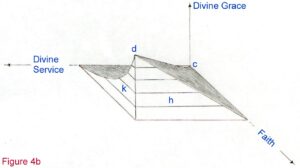
(For convenience, below are shown, again, two perspectives of the Cryptogram schematic for the benefit of the following discussions)
The Dual Nature of God
While the entire Structure describes the Holy Spirit in absolute terms, regions of the structure are classified as good or evil in relation to the Son’s position: Surface-b’s vector arrow portrays the Good Spirit guiding pilgrims to God the Son, whereas surface-a’s vector arrow depicts the Evil Spirit seducing them away from God the Son. Accordingly, all who succumb to the Evil Spirit are called antichrists. In keeping with this illustration, the Good Spirit’s disciples are engaged in an assemblage with God the Son (in the Heavenly Sanctuary). In contrast, the Evil Spirit’s cohort promote dispersion as antichrists. Indeed, as God the Son, Jesus anticipated these relevant features of the structure: “Whoever is not with me is against me, and whoever does not gather with me scatters.”
John identifies two groups of antichrists:
a) The apostates or self-righteous pilgrims on surface-a
Little children, it is the last time; and as you have heard that the anti-Christ is coming, so now many anti-Christs have come. This is how we know that it is the last time. They would have continued with us, but they went out from us, that it might be made clear they all are not of us (1 John 2:18-19; cf., Proverbs 2:13-15).
(The underline emphasizes that apostates on surface-a were former pilgrims on surface-b; they are thus backsliders. The same point had been made in Proverbs 2:13; and the vector arrows in Figure 4 illustrate it.)
b) The disbelievers on the earthly plane:
And every Spirit that fails to acknowledge Jesus Christ as come in the flesh is not of God; and this is that anti-Christ which as you have heard is to come; and even now it already is in the world (1 John 4:3; 1 John 2:22; 2 John 7).
The Evil Spirit and its followers (on surface-a) turn their backs on the light, the Son of God, for fear that their evil deeds and lies may be exposed, whereas those who belong to the Good Spirit (surface-b) face the Light, as their deeds are done in truth. These observations are depicted in the Cryptogram by the pair of opposing vector arrows (see Figures 4 & 6): One arrow points to the Efficiency Line—the light—while the other points away from it; thus affirming this scriptural passage:
For everyone who does evil hates the Light, lest his deeds should be exposed. But whoever acts in truth comes to the Light, so that his work may be clearly seen as done in God (John 3:20-21; cf., Jeremiah 2: 27b)
While surface-b represents the paths of truth, and surface-a, the paths of falsehood, the entire Structure represents Absolute Truth.
Inherent in the Spiritual Structure, therefore, is the absolute concept of God, which encompasses the positive and the negative, the good and the evil. In the Early Testament, it was described nebulously as “the blessing and the curse”, “life and death**”. These early references were precursors of Divine Justice embodied by the Spiritual Structure, which represents binary pathways by which an individual may choose to walk.
The corresponding theme—namely, the archetypal struggle between good and evil spirits—is encoded within the Cryptogram through the imagery of opposing vector arrows. One ascends toward the Efficiency Line, while the other descends from it, visually dramatizing the tension. Yet the Cryptogram affirms a decisive truth: the good spirit, as the superior power, ultimately prevails. This triumph is symbolically embedded at the structural junction where good and evil converge—the Heavenly Sanctuary—which stands as the embodiment of goodness. Notably, the Efficiency Line itself formed by the vector sum of two positive vectors on surface-b, reflects this affirmation by remaining inherently positive—see Figure 4.
There exists, paradoxically, within the spiritual structure, a certain harmony and unity composed of polar opposites; there is opposition, but no contradiction. Characterized by asymmetry about the Sanctuary, the structure is, nevertheless, the epitome of stability—the Rock***.
The significance of the dual nature of God derives from the difficulty encountered in the perception of God as wholly good, in the face of prevailing evil in the world, even though He is omnificent, omnipotent and omniscient. Thus far, the problem of evil had been attributed to another First Cause, the Devil (in an attempt to justify a wholly good God), thereby espousing, implicitly, a two-first-cause principle, an antilogy. In the Scriptures, the Devil is distinguished from God, as a separate personality, and identified as the originator of evil:
Now there was a day when the sons of God came to present themselves before the Lord, and Satan came also among them (Job 1:6).
Now Satan stood up against Israel, and provoked David to number Israel (1 Chronicles 21:1).
And He showed me Joshua, the high priest, standing before the Angel of the Lord, and Satan standing at his right hand to resist him. And the Lord said unto Satan: ‘The Lord rebuke you, O Satan . . .’ (Zachariah 3: 1-2)
You belong to your father, the Devil, and you want to do the desires of your father. He was a murderer from the beginning and does not stand in truth because there is no truth in him. Whenever he tells a lie, he speaks from his own nature, because he is a liar and the father of lies (John 8:44).
This foregoing notion of a purely Good God is irreconcilable with other scriptural passages. Indeed, the Lord was credited with causing some prophets to lie:
Now, therefore, behold, the Lord has put a lying spirit in the mouths of all these prophets of yours, and the Lord has declared evil against you (1 Kings 22:23).
The prophet Amos stated: “Shall evil befall a city without the Lord causing it” (Amos 3:6)? Several other passages in the Scriptures also attributed evil to God:
The reason they could not believe was that as Isaiah said: ‘He has blinded their eyes and hardened their heart that they should not see with their eyes nor understand with their heart and be converted and I would heal them’ (John 12:39-40; Isaiah 6:9-10).
For the inhabitants of Maroth waited carefully for Good, but evil came down from the Lord to the gate of Jerusalem (Micah 1:12).
The following day, an Evil Sirit from God came over Saul, and he raged in his house, while David was playing the Lyre, as was his wont. With his spear in hand, Saul cast it with the intent of striking David. But twice, David eluded him (1 Samuel 18:10-11).
‘See, now, that I, even I, I am He, and there is no god besides me: I kill, and I make alive; I wound, and I heal; neither is there any that can deliver out of my hand’ (Deuteronomy 32:39).
‘I form the light and create darkness; I make peace, and create evil; I, the Lord. do all these things’ (Isaiah 45:7).
These scriptural passages, obviously, portray God in a negative sense, contrary to the prior cited passages; they imply, indirectly, that the Spirit of God is also inherently dual by nature. This Early Testament concept, however, focuses more on God’s retribution of infidelity to Him, and less on evil as an inherent nature of God. Thus, the idea of evil was kept apart from God. Nowhere in the Scriptures is the dual nature of God stated, explicitly. Even so, according to the passages, God brought on the evil in each case.
The Comprehensive Nature of God
Throughout Scripture, the depiction of God’s nature appears inconsistent across various passages. The only coherent representation of the Divine is one that encompasses Its total spiritual attributes, as portrayed by the Cryptogram— the interplay of good and evil spirits, Duality, paradoxically Unified within the Trinity.
While the Trinity denotes the distinct manifestations within the singular spirit irrespective of orientation, duality specifically addresses the differentiation within the spirit based on orientation. However, both classifications pertain to the Absolute Spirit. Accordingly, the Divine is expressed as Three Persons, unified within Two Forms, collectively constituting One universal God.
The Trinity pertains to the distinctions made within the Unitary Spirit on a vertical basis, with respect to its Architecture, whereas the Duality relates to the transverse differentiation within the same Spirit. This Supra-cosmic Spirit manifests Itself readily in nature in its Binary form. The Binary mode of this Spirit is basically two-dimensional, with respect to its Architecture, that is, it is on the earthly plane, whereas Its Trinitarian aspect is of higher, spiritual dimensions, and thus more difficult to discern.
Consequently, the unveiling of the Cryptogram constitutes the revelation of the form of God’s nature—a profound insight into the Divine. (See the Gospel of Thomas 30 for a subtle reference to this comprehensive conception of the Divine.)♠.
God-Humanity Relationships
The Cryptogram embodies duality through its opposing surfaces, a and b, forming an intricate dialogue between good and evil. To decode this relationship, one must distinguish between two interconnected expressions: moral Good-and-Evil, which arises from Choice, shaped by individual agency, and natural Good-and-Evil, which stems from Chance, dictated by uncontrollable circumstances. This distinction reveals that the Cryptogram is not a mere opposition but a dynamic system where agency intersects with destiny.
At its core, the Cryptogram emphasizes the moral dimension of Divine Justice grounded in Choice, while subtly acknowledging the influence of Chance, reflecting the profound connection between God and humanity. In other words, how an ascendant pilgrim conforms, by Choice, to the necessary, changing contour of the Chance Mold—the Potential Structure—is a measure of the pilgrim’s loyalty to the Divine.
Within this justice system, the ultimate reward is eternal bliss with the Good Spirit, while the ultimate punishment is eternal torment with the Evil Spirit. The criteria for judgment are based on one’s adherence to the teachings of the Holy Spirit throughout life. While each individual’s fate is uniquely shaped by circumstances, one universal truth prevails: the journey, inherently good, is marked by an uphill struggle. Those who seek to evade this challenge ultimately stray into forbidden domains.
Thus, the Spiritual Structure is portrayed as a sacred framework consisting of permitted and forbidden spiritual paths, where each soul must decide its own course.
Building on the preceding discussion, the traditional search for a theodicy was inherently flawed, as it treated evil as an isolated force rather than recognizing its integral role within the divine nature. According to the Cryptogram, the Spirit of God encompasses both infinite goodness and infinite evil. Instead of possessing one attribute to the exclusion of the other, the divine essence reconciles these opposing forces within its singular nature—an embodiment of Divine Justice. Even so, the Good Spirit remains the superior force within the framework as demonstrated in ¶6:26.
To the extent that evil is personified as the devil, it does not exist independently but rather remains within the all-encompassing structure of God’s nature. The presence of such paradoxes within the unitary spirit constitutes a fundamental mystery of the Divine—one that challenges conventional theological perspectives. Accepting this novel scriptural concept of God requires a dispassionate reassessment of long-held doctrines, demanding the rejection of superficial interpretations and misguided notions about the Divine.
The aspect of God’s nature that an individual ultimately encounters— whether its benevolence or its wrath—is determined by their own choices. This is the essence of Divine Justice. Thus, prophets and preachers are sent as witnesses: to the righteous, they bring hope and affirmation, while to the wayward, they serve as solemn harbingers of judgment, standing as evidence against them on the Day of Reckoning.
As depicted by the Cryptogram, the attainment of goodness involves an uphill climb, and so, advancement in grace inherently implies overcoming ordeals: the downhill resistance of evil. This is especially the case with those pilgrims in the Heavenly Sanctuary—the highest points of divine grace in the structure, as noted by Paul:
For I think that God has set forth us the apostles last, as it were, appointed to death; for we are made a spectacle unto the world . . . (1 Corinthians 4:9-13; Romans 8:36).
However, they also have sufficient grace to combat the evil that confront them. Therefore, the more one seeks and attains goodness in God, the greater the natural evil (temptations and/or misfortunes) that befalls one; and hopefully the more grace one acquires for combating it.
The Heavenly Sanctuary, the abode of the Absolute Spirit, is the knife edge on which the scale-beam of Divine Justice rests. Advancement on this critical path entails balancing the caution and vigilance necessary for avoiding evil against the abandon and zeal required for accomplishing one’s duties in life: balancing aversion to evil (surface-a) against the passion for righteousness (surface-b). This is, essentially, the law of God expressed in two dimensions; the Cryptogram, in its totality, is a three-dimensional illustration of it—the Consummate Law. Thus, to be in the Heavenly Sanctuary is, for a pilgrim, to be in a state of dynamic equilibrium. Denizens of this divine court must be able to absorb opposite perturbations with equanimity if the necessary balance is to be maintained on this knife edge: misfortunes must be humbly accepted with the good in life. So, natural evil must be seen as opportunities for spiritual advancements being part of the comprehensive milieu appointed by God for accomplishing Its will for humanity.
The elegance and seeming simplicity of the spiritual structure, as the solutions to the problem of evil, are indeed hallmarks of divine nature.
The Magnetic Field and Compass
God the Son (the Efficiency Line) has already been likened to a magnet. Now, the Holy Spirit—the Macrocosmic Structure—can be viewed in terms of the sum of the magnet and the magnetic field. The directions of the magnetic field correspond to the directions of the grace vector field in Figure 4. Just as latent magnetic lines are outlined by the presence of magnetic substances (such as iron filings), the spiritual pathways—the Potential Structure— are revealed as the Apparent Structure by the presence of pilgrims.
The importance of the Holy Spirit to pilgrims can be likened to the relevance of the Earth’s magnetic field to compasses. Just as a ship’s compass is reliant on the Earth’s magnetic field for navigational bearings, so a pilgrim’s conscience is dependent upon the Holy Spirit for spiritual guidance. While the Earth’s magnetism is the common link that binds all magnetic compasses, truth is the common factor that binds all consciences. In essence, the Holy Spirit is the field or domain of Absolute Truth. Jesus, in fact, described the Holy Spirit as the Spirit of Truth (John 14:16-17; 15:26; 16:13).
Therefore, to, deliberately, disobey after knowing the Truth is a sin against the Holy Spirit, which is the unforgivable sin: the deadly sin. The Scriptures certified:
For if we sin willfully after we receive knowledge of The Truth, there remains no more sacrifice for sins, but a certain fearful looking for of judgment which shall devour the adversaries (Hebrews 10:26-27; Gospel of Thomas 44; Mark 3:28-29; Matthew 12:31-32; Luke 12:10).
The bearings indicated by a magnetic compass are interpreted in relation to a fixed axis—the north-south poles. Similarly, the orientation of an individual’s conscience—positive or negative—is assessed with reference to a fixed axis in the spiritual structure—God the Son. A positive conscience, founded in faith, is directed toward eternal life in the Son, through grace (surface-b), while a negative conscience, based on self-righteous actions, is directed away from the Son toward death, through sin (surface-a).
In order to approach God, one must align one’s self positively with grace, much as a compass needle. The Word of God helps a pilgrim develop a protective shield: to resist temptation and enhance its judgment, similar to the way a magnetic compass is shielded from interference that may affect its accuracy. The effectiveness of this protective shield depends on the depth of one’s knowledge of God’s Will. The individual lacking knowledge of God’s Word is akin to a captain navigating a ship equipped with an erratic compass.
No matter how accurate a compass may be, it merely provides guidance; it is not responsible for the ship’s motion. By the same token, the conscience provides only guidance. An individual advances in holiness only by acting according to a truthful conscience.
The Radio Signal
The Holy Spirit is poured out into the world from the Heavenly Sanctuary, just as radio waves are beamed from a transmitter. With the gift of faith, a pilgrim becomes equipped with the appropriate receiver (conscience) for tuning into this perennially ubiquitous signal (the Instant Word of God). In order for these receivers to function, they require conditioning, that is, bias voltage from a power source (the General Word of God). However, the reception is subject to interference, insofar as the receivers are located in a noise zone (amidst falsehoods). The quality of the reception is, therefore, dependent upon both the atmospherics and the sophistication of the circuits designed into the receivers. A sensitive receiver is one that sorts out faint signals, amidst a noisy background. By analogy, a wise conscience is also one that sorts out truths from a complex situation. A high-fidelity system is one that hears the Word of God and keeps it.
Flared like a megaphone, the Cryptogram signifies the final amplification of the divine whisper heard by Elijah on top of the mountain (1 Kings 19:12-13) ♣; and since it symbolizes the Third Person of the Trinity, the Holy Spirit is the Consummate Word of God—the Consummate Law and the Will of God.
53 The preceding discussion is all in keeping with Jesus’ prophecy about the Holy Spirit: “The Advocate . . . whom the Father will send in my name, He will teach you all things, and remind you of all that I have told you” (John 14:26).
The Cryptogram Affirms Other Scriptural Passages
While one’s actions cannot be directly attributed to grace, they remain subject to its subtle influence. Considering the analogy of the “Structure” alongside the Magnetic Field and Compass: On surface-b, where the magnet asserts an attractive influence, the higher the position of a pilgrim’s compass the more defined their compass needle becomes, minimizing confusion and aiding their upward mobility toward the “Author of Life in the North”. (Those rich in grace are not easily overcome by temptation.)
Conversely, on surface-a, where the magnet asserts a repulsive influence, the compass is directed away from life, and thus the apostate is led astray toward “Death’s Agent in the South.” The Cryptogram, therefore, bears witness to this passage:
For whosoever has to him shall be given and he shall have more abundantly; but whosoever has not, from him shall be taken away even what he had (Matthew 13:12; 25:29; Mark 4:25; Luke 8:18).
Without reference to the Cryptogram, this passage would fly in the face of anyone’s sense of justice; yet, it remains a reflection of the paradoxical nature of the Divine.
The Cryptogram also bears witness to the scriptural admonition:
Therefore, come out from among them. And separate yourselves from them, says the Lord, and touch nothing unclean and I will receive you, and I will be a Father to you, and you shall be my sons and daughters (2 Corinthians 6:17-18).
The apostates, on the other hand, unable to resist the lure of worldly passions are portrayed in the Cryptogram as heading to where their hearts and minds are—on the earthly plane. Indeed, the Scriptures cautioned:
Lay not up for yourselves treasures upon the Earth, where moth and rust corrupt, and where thieves break through and steal; but lay up for yourselves treasures in Heaven, where neither moth nor rust can corrupt, and where thieves do not break through nor steal; for where your treasure is there will your heart be also (Matthew 6:19-21; Luke 12:33-34).
* Indeed, Jesus described traits of the Spirit as ‘motion and rest’—Gospel of Thomas 50.
**Deuteronomy 30:15-20; 28:1-14; 15-69; See, also, (Zoroastrian) Yasna 30; 3-6.
***Compare the Cryptogram with Heraclitus’s Logos and his doctrine on the unity of opposites. With the benefit of the Cryptogram, the ambiguity of Heraclitus’s aphorisms exploited by Plato and Aristotle has been eliminated; they imputed to Heraclitus the identity of opposites, and the denial of non-contradiction.
♠For another hint at the Comprehensive Nature of the Divine, see Tao Te Ching (42). Even here, the Structure (that is, the Taijitu) portrays its vector (or sense) attribute: “All things have their back to the Female (the Yin), and stand facing the Male (the Yang)”.
♣Elijah heard the whisper as the Most High’s Alter Ego: One close to God.