The Capstone: The Supreme Cornerstone
The identity of the messianic capital is inseparably bound to the mystical rock of Zion:
Thus says the Lord: ‘Behold, I am laying a Stone in Zion [Ahaba], a tested Stone, a precious Cornerstone, as a sure foundation: he that believes in it shall not be moved’ (Isa. 28:16).
Though this Scripture has often been applied superficially to Jesus in relation to the Old Zion—as the Pre-exalted Christ—it finds its literal and consummate fulfillment in the Exalted Christ, the Holy Spirit, and the New Zion, Ahaba, through Nnebisi. This interpretation accords with the role of the Holy Spirit as the Supplanter, the One who establishes the new in place of the old. In this sense, He is identified with Jacob and is at times invoked as the God of Jacob.
Nnebisi was born a slave in the town of Nteje, east of the Niger River, in Nigeria. His origins were shrouded in mystery—he had no father, only a mother whose presence carried an air of the extraordinary (cf., Hebrews 7:3). As a child of lowly birth, he endured humiliation and scorn. One such moment came during the town’s annual festival, a celebration that honored the strongest and most heroic man. On this occasion, a powerful bull was released into the wild, and the young men of Nteje were challenged to capture and lead it back. The victor was crowned with the emblem of courage and strength: the bull’s tail.
Nnebisi, tall and powerfully built, towered above his peers. When he came of age, he joined the contest and, on his very first attempt, subdued the bull and led it triumphantly back to town. Yet, instead of receiving the honor due him, the judges inexplicably released the bull again. Twice more Nnebisi captured and returned it, and twice more the honor was withheld. What should have been glory became shame, leaving him wounded in spirit.
In the wake of this injustice, Nnebisi’s mother resolved to set him free. She summoned him to the marketplace at dusk, when the stalls were empty and silence hung in the air. As he approached, he saw her walking upside down, balancing her basket upon her feet. She performed other unsettling feats, each designed to test his courage and readiness for the mission that lay before him. Nnebisi did not falter; he stood firm, unshaken by fear.
Having passed these trials, his mother entrusted him with a sacred task. She gave him a table stone to carry across the Niger River into the sparsely settled land to the west. Wherever the stone fell, she instructed, there he was to make home. Upon reaching the far bank, the stone dropped at the foot of a hill— today known as the Shrine of Onishe, the cornerstone of New Jerusalem. At that moment Nnebisi declared: Ahabam (“I settle here”), and thus the town of Ahaba was named, fulfilling the prophecy: “[Jerusalem] shall be called by a new name, pronounced by the mouth of the Lord” (Isa. 62:2).
The Spirit of the Lord indeed came to dwell in Ahaba, marked by the resting of that stone. Through Nnebisi, the “Tested Stone,” the divine word was fulfilled: “I am laying a stone in Zion,” says the Lord. From his lineage came the Consummate Messiah—recognized as the Alpha and the Omega, the Beginning and the End, the Cornerstone and the Capstone—the Cherubim. In Him, Scriptures finds its literal fulfillment. He is the embodiment of faith, the sure foundation of righteousness, recognized in Romans 9:32 as a stumbling stone to natural Israel.
Come to Him, a Living Stone, rejected by humans, but chosen and precious in the sight of God (1 Peter 2:4).
To you, therefore, who believe, the Stone is [a refuge, and as such] precious; but to unbelievers, it is rather a Stone which the builders rejected that has become the Head of the Corner [the Capstone]; a Stumbling Stone and a Rock that will make them fall. Those who stumble are the disbelievers in the Word of God [Olisadumkwu]*; it is their appointed fate to do so (1 Peter 2:7-8).
This rock, Zion, the table of the Consummate Law, the eternal Ark of the New Covenant, is the Throne of the Supreme God: The Seal of the secret bond of kinship between God the Mother, Onishe, and Nnebisi—the Impersonal and Personal Absolutes. It is presently evident in Asaba. Hence, the Scriptures prophesied:
For that which has not been told them they shall see, and that which they have not heard they shall understand (Isa. 52:15).
Jeremiah espied these Events and, accordingly, prophesied the transience of the phantom ark. He was moved to prophesy further:
At that time, they shall call [New] Jerusalem the Throne of the Lord; and all the nations shall be gathered unto it, to the name of the Lord: [The Rock] (Jer. 3:16-17).
The prior Scriptures had identified the cornerstone abstractly with the Pre-exalted Christ, Jesus, but now is made manifest concretely with the Exalted One, Elijah. Other messianic emblems share these correlations also; such as the Divine Seal, the divine fire and the spiritual sword.
Just as Abraham marked the beginning of the Old Covenant that terminated with Jesus, so Nnebisi personified the budding Spirit, Alpha: The beginning of the New Covenant, which culminated in Elijah, the Omega. The former covenant is associated with the transitory ark and the Aaronic-high-priest, whereas the latter is identified with the eternal, Messianic-High-Priest and the Heavenly Throne, Zion. Yet, they are both integral to God’s Grand Plan for humanity.
Nnebisi’s River Crossing
In the two-dimensional, earthly sense: By going from east to west, Nnebisi crossed, as it were, from the domain of the unjust to that of the just, from the realm of the natural to that of the potential spiritual, as depicted in the Cryptogram, and symbolized by the baptism of water.
In the higher-dimensional sense on surface-b, Nnebisi’s crossing embodies the pilgrim’s mystical journey (symbolized by the baptism of water and the Spirit): burdened by innate limits yet sustained by faith, he wades through the uncertain currents of cosmic stream toward that bank of repose—the New Jerusalem. There, the burden is transformed into a fountain of Spirit, the gift that renews.
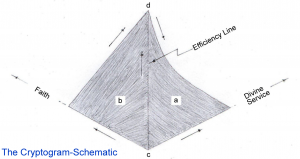
From the Supreme Godhead [d] humanity came by imperfection, and thus have fallen (on surface-a); and to It all must strive, freely, to rise (on surface-b) and thus return—to Perfection—through these transitions in the Structure.
Further Evidence for The Ultimate Messiah
The origin of The Messiah, the Exalted One, had been rightly a point of contention for Jews of Jesus’s time:
Yet, we know where this man [Jesus] is from. When the Messiah comes, no one is supposed to know His Origin [insofar as He is not of Judah’s stock, but a type of Melchizedek] (John 7:27 c.f., Gen. 49:10).
Accordingly, Heaven divulged to Ezra: “One shall reign whom those who dwell on Earth do not expect . . . and one whom the many do not know shall make His voice heard by night” (4 Ezra 5:6-7). It is all in keeping with the testimony in Scripture: “[S]he concealed me in the shadow of H[er] arm . . . in H[er] quiver [S]he hid me” (Isaiah 49:2). Indeed, mystery is another messianic motif: from the Cryptogram to His cryptonyms; hence, the Messiah is the Seal of Secrecy—the Mystic Rock.
Paul observed:
I do not, brethren, want you to be ignorant of this mystery lest you be conceited: blindness has afflicted part of Israel until the full number of Gentiles enter in, and then all Israel will be saved. As it is written: ‘Out of [New] Zion [Ahaba: The Dwelling of God the Highest] will come the Deliverer who shall remove all ungodliness from Jacob . . .’ (Rom. 11:25-26)
If Jesus were indeed the Ultimate Messiah, then the need for another Deliverer as prophesied by Paul would not exist. Various passages in the Scriptures depict messianic characteristics that do not align with Jesus as a person: “the despised one rejected by men . . . one of those [a race] from whom men hide their faces; spurned and held in no esteem” (Isaiah 53:3); “the servant of rulers, loathed by nations” (Isaiah 49:7); “a worm and not a man, scorned by mankind, despised by the people” (Psalms 22:6).
Yet, the given name of this author—Olisadumkwu (may God help me speak): the Word of God; Obiaya (One who has come to war [against (the Evil in) God]): Israel (Revelation 19:11-13; Isaiah 49:3) aligns Him with the ultimate Deliverer and revelator, indicating the fulfillment of the times in Paul’s prophecy. The name “Obiaya” embodies what was attributed in the Scriptures to the Chosen Servant: “S[he] made my mouth like a sharp sword . . . S[he] made me a polished arrow . . .” [Indeed], “S[he] gave me my name . . .” (Isaiah 49:1-2).
As the foregoing passage testifies: “Blindness has afflicted part of Israel, until the full number of Gentiles enter in, and then all Israel will be saved” by the Deliverer; thus, the first is last and the last is first.
The Ultimate Messiah and His clan are often differentiated from the tribes of Jacob; and their earthly origin identified with Zion. Indeed, the above passage distinguishes the ultimate Deliverer and Zion from the tribes of Jacob and identifies the Deliverer as coming from without to redeem Jacob: “Out of Zion will come the Deliverer” (The Standard Spirit: the Consummate Law and the Word of God) so prophesied Paul.
Other passages affirm Paul:
And many peoples shall go and say, ‘Come and let us climb the Mountain of the Lord [Zion], to the house of the God of Jacob [i.e., the Holy Spirit]; and He will teach us of His ways, and we may walk in His paths.’ For out of [New] Zion [Ahaba] shall go forth the [Grand] Law, and the Word of God [Olisadumkwu] from [New] Jerusalem. And He will judge among the Nations and will rebuke many people . . . (Isa. 2:3; Micah 4:2).
Ezra, too, prophesied the co-Manifestation of the Exalted One with His Heavenly “Base”, (New) Zion:
But, He shall stand on top of Mount Zion. And Zion will come and be made manifest to all people, prepared and built as you saw the Mountain carved out without hands (2 Esdras 13:35-36 or 4 Ezra 13:35-36).
Thus, Ezra envisioned the Lofty One “standing on” (the exposition of) Mount Zion, a position that empowers Him to rebuke and vanquish the nations (4 Ezra 13:37-38). This manifestation heralded the revelation of New Zion, with the Exalted One recognized as the Most High**: the King of New Zion, Melchizedek —fulfilling the divine decree: “I myself have set up my King on [New] Zion, my Holy Mountain” (Psalms 2:6).
His mysterious emergence from the heart of the sea alluded to the enigma of His origin [Ahaba] (4 Ezra 13:51-52). And since New Zion was to be “prepared and built as you saw the mountain [i.e., the Cryptogram] carved out without hands” from a hidden realm, this “carved mountain” was to serve as divine model for the New Zion. Thus, Ezra’s vision has been realized: the Lofty One now stands upon (the exposition of) Mount Zion, the “carved mountain” has materialized, and New Zion—the messianic capital—has been revealed.
Furthermore, the sacred texts foretold♥ the arrival of an Exalted Messiah, a Most Holy One—ordained to succeed a prior Anointed One, Jesus. He shall restore all things, ushering in the New Jerusalem, the eternal city, destined to replace the former sanctuary, whose desolation has been decreed. This Anointed Prince, chosen from a different people, will fulfill a divine purpose foretold by prophecy. His reign shall bring transformation, and He will wage battle until the appointed end (1 Corinthians 15:24, 28).
Jesus recognized Elijah as this (anointed) restorer: “Elijah truly shall first come and restore all things . . . ” (Matthew 17:10). Again, the Scriptures bear witness:
And He said, it is a light thing that you should be my Servant to raise up the tribes of Jacob, and to restore the preserved of Israel. I will give you as a light to the Gentiles that you may be my salvation to the end of the Earth . . . (Isa. 49:6)
Thus, the Servant of the Lord is the supreme salvation for all—both Gentiles and Jews alike.
(This is an excerpt from the Book between Pages 193-199)
* Accordingly, the pilgrim’s “Goal” is, at once, a Stumbling Stone and a Rock of Refuge: In one respect, It is a Gemstone at the Ridgepole that steers the faithful to refuge in New Zion; and in another respect, a black, hidden Rock in a dark seamy Valley, by whom the unwary stumbles. And so, He is both a Cynosure and a Pitfall on Mount Zion.
** Here, the Emblem served to express the Elect One’s Eminence; otherwise, It gives voice to His Mission. It is remarkable that the title of the God of Melchizedek, a Canaanite, was acknowledged in the Scriptures: The “Most High”. This title anticipated Nnebisi: (God the) Mother is “Supreme”. Thus, Nnebisi’s priesthood connotes the order of Melchizedek.
*** The “Carved Mountain”—the Cryptogram—is abstract: Derived from combustion, it is independent of place. Hence, Ezra could not tell where the Mountain came from (4 Ezra 13:6-7). It is, also, distinct from Mount Zion, being the model of Mount Zion instead of the Real Place.
♥ (Daniel 9:24-27). This prophecy circumscribed a period for the Jews and their holy city—as interim Agents of Justice—before Divine Authority would shift to a New Princedom. The time is up for the Jews and their holy city. And so, a New Leader (Elijah) has been anointed, and the Old Jerusalem forsaken for a New One. Significantly, the prophecy specified milestones in the Succession Era: “Everlasting Justice [firmly based upon science] will be introduced; vision and prophecy will be ratified; and a Most Holy One will be anointed”. Then, the “transgressions [of Judah] will cease; [her] failings will end; and [her] atonements for sins will end”. Moreover, the New Leader was said to be of a different race (v. 26), distinct from another Anointed One who would be cut off (Jesus). Much as in Ezra’s vision (4 Ezra 9:23ff), the destruction of the old sanctuary (Jerusalem) was prophesied here, too (v. 26). In concert with the time limitation for the Jewish holy city, the rebuilding of Jerusalem here accords with a New City. (Again, the Exalted Messiah has been linked with the New City, v. 25). While Ezra’s vision focused on the relocation of the Messianic Capital and the demise of Old Jerusalem, (See last ¶ in Blog Post 2), here the shift of Authority related to the Messianic Succession: from One Anointed who would be cutoff to the Most Holy One [c.f., Gen. 49:10]. (Again, the use of specific times—weeks—in this Daniel’s passage had been a red herring. The relevant markers are the specified milestones.)