The History and Origin of The Spiritual Structure
In accordance with the Divine Plan, God established a framework through which humanity would unite with Him. Abraham chosen as an instrument of this purpose, exemplified productive faith*—a faith manifested through divine service (obedience to God’s Law). Though this was present in its embryonic form, it lacked full definition at the time, later clarified through Divine Revelation. Psychic faith, the internal believe aligned with God’s saving plan was defined through the Son and ultimately through the Holy Spirit. The laws first given through Moses and later refined by Jesus, shaped the foundation of the Spiritual Mountain—the elevated structure of divinity.
Through Abraham’s productive faith, God credited him with justice and made him the father of many nations, promising a land rich with milk and honey. While this promise materialized in the natural realm, its true fulfillment is found in the spiritual sphere—Mount Zion, the pinnacle of divine communion.
God renewed His covenant with Abraham’s descendants, beginning with Isaac and continuing through Jacob, later named Israel. During a time of famine, Israel and his twelve sons migrated to Egypt, where they endured years of enslavement. Their liberation led by Moses, marked a pivotal moment in divine history. In the desert, God sustained them with manna from heaven, sheltered them by day, and illuminated their path by night.
Upon reaching Mount Sinai, this chosen people received laws to guide their actions—the first structured moral and ritual code provided to humanity. Moses relayed the prophecy of another divine messenger to come:
I will raise up for them a prophet like you from among their brethren and will put my word in His mouth and He shall speak to them all that I shall command Him. And it shall come to pass that whosoever does not listen to my words which He shall speak in my name, I will make him answer for it (Deuteronomy 18:18-19).
This marked the introduction of the Mosaic Law, a system centered on legal observance. Through this preliminary code, divine service—one element of productive faith—was introduced. However, psychic faith, true belief defined in relation to the Trinity, had yet to be revealed. At this stage, only a quasi-faith existed, one that operated in union with the law. Paul later explained:
But before faith came, we were kept under the law, shut up unto the faith which should afterward be revealed (Galatians 3:23).
The Old Covenant system was restricted to two variables: God’s providential care (dependent) and obedience to the law (independent). Thus, its response field—salvation—was limited to a two-dimensional earthly plane. Consequently, the blessings and the curses within this system were temporal (Deut. 28), contingent upon adherence to the law. But the law was complex, ritualistic, and rudimentary; its focus remained on procedural correctness. And by this measure, the Israelites could hardly remain justified for long. As the Scriptures observed:
Wherefore I gave them also statutes that were not good, and precepts whereby they could not live (Ezekiel 20:25).
As the people journeyed through the desert and into the promised land, they faced continual trials and opposition. Over generations, God raised prophets among them, who foretold a new era and the coming of a Messiah who would bring deliverance. John the Baptist, herald of this transition, preached repentance and baptism for the forgiveness of sins, preparing hearts for the foundation of a divine structure. Isaiah anticipated his role:
A voice crying out in the wilderness: ‘Prepare you the way of the Lord, make straight His paths’ (Matthew 3:3; Isaiah 40:3-4).
With the arrival of Jesus these prophecies found fulfillment. Paul succinctly explained His role:
But when the appointed time had come, God sent forth His Son, made of a woman, made under the law, to redeem those who were under the law, that we might receive the status of adopted sons (Galatians 4:4-5).
The birth of Jesus marked the advent of the new faith, and the incipience of the Kingdom of God on Earth. While on Earth, Jesus modified the Mosaic Law—stripping away external rituals while preserving the ideal law of God— and preached the good news of the kingdom.
Initially, the modified law remained coupled with the quasi-faith of the Old Covenant. However, a pivotal moment occurred when Simon, one of Jesus’ disciples, recognized Him as the Son of God—through whom the Holy Spirit would come. He was the first just person to profess the true faith, replacing the quasi-faith of the old system. Consequently, faith became liberated from its union with the modified law, yielding two independent variables—the new faith, and obedience to the modified law—instead of the single, independent variable of the old system: obedience to the Mosaic Law.
Through Simon’s declaration, faith and divine service were established, independent elements—thus laying the foundation for the Cryptogram—the three-dimensional spiritual structure. Whereas the old system confined salvation to a two-dimensional, earthly plane, the new framework allows movement within higher-dimensional planes, offering the expansive reality of divine unity. In the old system God-humanity relationship was transcendent but the new granted it immanency, a framework to approach God by degrees.
In a parallel development, Simon’s profession of faith catalyzed the unfolding of the flower bud—Jesus—that had sprouted from the stump of Jesse allowing divine purpose to manifest fully. Until this moment, the stump had never yielded life-giving fruit, signifying the unprecedented nature of the event.
To mark this memorable occasion, Jesus renamed Simon Peter, meaning Rock, the recognized symbol of the divine structure—the Cryptogram—the foundation of which had just been laid through Simon. With this foundation laid, Jesus began unveiling the deeper dimensions of faith and His sacrificial agency: that He would suffer, die, be buried, rise on the third day, and ascend to the Father. He emphasized that unless these events transpired, the Holy Spirit would not come (cf., John 16:7)—meaning that the structure would remain incomplete, and faith would not reach its consummation. At this stage, only the foundation had been laid; the supporting beam was yet to be established.
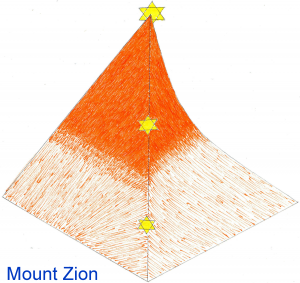
Three days after His crucifixion, death and burial, Jesus rose and ascended to the Father. Through this ascension of Jesus, the beam—cornerstone—of the spiritual structure was raised, bridging the earthly plane and the Heavenly Throne. At that moment, the floodgates of Heaven opened, initiating the outpouring of grace—the Holy Spirit—into the world. This effusion enabled the pathways of faith, linking the earthly plane with the beam and providing the children of God access to the Heavenly Sanctuary—thus, faith was being consummated.
While the Holy Spirit, the Good Spirit (surface-b of the Cryptogram), was being poured out to the world from Heaven, the Evil Spirit also emanated from Heaven. Jesus foresaw this occurrence: “I saw Satan fall like lightning from Heaven” (Luke 10:18).
In summary, the ground for the foundation of the divine structure was prepared by John the Baptist, the foundation itself was laid through Peter, and the cornerstone was erected through Jesus, thereby initiating the formation of the framework of justice. This pattern echoes Abraham’s justification—faith expressed through action.
The Scriptures affirm the destiny of those who ascend this structure:
Now, therefore, you are no longer strangers, and foreigners, but fellow citizens with the saints, and members of the Household of God. You form a Building which rises upon the foundation of the apostles and prophets [who are represented by Peter and John the Baptist], Jesus Christ, Himself, being the Cornerstone. Through Him the Whole Structure is fitted together and framed as a Holy Temple in the Lord: to become a Dwelling place for God in the Spirit [that is, Mount Zion] (Ephesians 2:19-22)
Thus, the realism of this mystical structure is portrayed in the Scriptures.
Through this Structure—the Holy Spirit—God’s eventual promise of salvation becomes a reality for all those who ascend through productive faith. Thus, the Holy Spirit is ultimately the consummate salvation of the world. As a living entity, this Apparent Structure is capable of growth, and every pilgrim serves as a building block within it. Consequently, each pilgrim bears responsibility for fostering this growth to fully experience the fruits of divine love. By deepening their knowledge and understanding of God’s Plan, pilgrims can enhance their potential for meaningful contributions to the growth of the structure. However, only through dedication to God in the Trinity—expressed through positive action—can these contributions be realized.
Let each person, therefore, strive for greater spiritual heights actively participating in the development of the structure rather than remaining stagnant at its foundational levels.
This sequence of events illustrates how God the Father, as Architect and Builder, oversaw the establishment of His Kingdom on Earth. The inauguration of this structure—the kingdom—was the central purpose of Jesus’ coming, and the core theme of His Gospel.
The Old and The New Spiritual Structure
While the Apparent Structure** is newly manifested, the underlying Potential Structure is eternal, without beginning. Before the outpouring of the Holy Spirit, the Potential Structure was symbolically transformed into the form of human flesh in the person of Jesus—the incarnation. Through Jesus’ passion, death, resurrection and ascension into Heaven, and the subsequent outpouring of the Holy Spirit, the Potential Structure was renewed, opening the path for humanity to ascend into union with it through participation in divine life.
It is in this sense that Jesus spoke, saying: “Destroy this temple, and in three days I will raise it up” (John 2:19). His bodily temple became the vessel of transfiguration, where the old structure was transfigured into a sanctuary for humanity’s engagement with the Divine.
The Scriptures attest to this renewal:
The former things have passed away. And He that sat upon the Throne said: ‘Behold, I make all things new’ (Revelation 21:4-5).
They also affirm its consummation: “It is done” (Revelation 21:6).
Before this renewal, God remained transcendent and unapproachable to humanity. In the Early Testament, glimpses of the eternal Potential Structure appeared symbolically through references to the Rock—a veiled form of the divine foundation:
For who is God save the Lord? And who is a Rock save our God (2 Samuel 22:32; Psalms 18:31)?
The Rock: How perfect are His deeds! How just all His ways! (Deuteronomy 32:4).
For you are my Rock and my fortress, therefore, for your name’s sake lead me, and guide me (Psalms 31:3).
But the Lord is my defense, and my God is the Rock of my refuge (Psalms 94:22).
In that earlier era, these passages were understood on a natural level: God, the Rock, delivered Israel from temporal enemies. Yet, in the new era, they reveal a deeper spiritual meaning. The Rock now signifies not only refuge and justice, but the eternal structure renewed—the foundation through which God enacts His ultimate plan for the salvation of all humanity.
The Tree of Life
By Jesus’ last Passover, the flower bud that had sprouted from Jesse’s stump—blossomed through Peter’s profession—had ripened into a mature fruit. On that sacred day, Jesus offered His disciples a taste of this first fruit. Through His death and burial, the seed of that fruit was planted outside of Old Jerusalem —marking the burial of the last remnant of Jesse’s stump—the Old Order.
From that seed sprang a new life. At Pentecost, the outpouring of the Holy Spirit marked its germination, giving rise to a Young Plant—a new order— bringing shelter and life-giving fruit to members of God’s household.
This tree, which symbolizes the Holy Spirit, always was, is now, and ever shall be. Once forbidden to humanity (Genesis 3:22-24) its fruit is now offered freely to all who seek wisdom and eternal life through a faith that bears fruit in the spirit:
Whoever has ears should listen to the Spirit’s words to the Churches: He that surmounts [Mount Zion] will I give to eat of the Tree of Life, which is in the midst of the Paradise of God (Revelation 2:7).
{This Blog Post is an excerpt from the Book, between Pages 101-106}
Definitions
* Faith which is independent of action is referred to as psychic faith; in order to produce fruit, psychic faith must be coupled with positive action. Faith that is confirmed through positive action is referred to as productive faith. Whenever the word faith is used alone her, it will be in reference to psychic faith.
**The Spiritual Structure consists of an infinite number of potential, latent pathways leading to and from the Heavenly Sanctuary—The Potential Structure. The pathways leading to the Heavenly Sanctuary compose the Good Spirit, while those leading away from the Sanctuary constitute the Evil Spirit. And the entire Potential Structure represent the Holy Spirit. However, it is the pilgrims who ascend and occupy these pathways that outline or reveal the Structure, and thus define the size of the Apparent Structure. Just as iron filings reveal a latent magnetic field, so pilgrims manifest the Holy Spirit in the Structure. Growth in the population of the pilgrims, and their advancement to higher spiritual heights result in increase in the size and height of the Apparent Structure. The Structure, then, has both a Potential or Absolute Peak of infinite height, and an Apparent Peak capable of infinite growth. Jesus’s parables of “the mustard seed”, and “the leaven bread” relate to this growth process.